
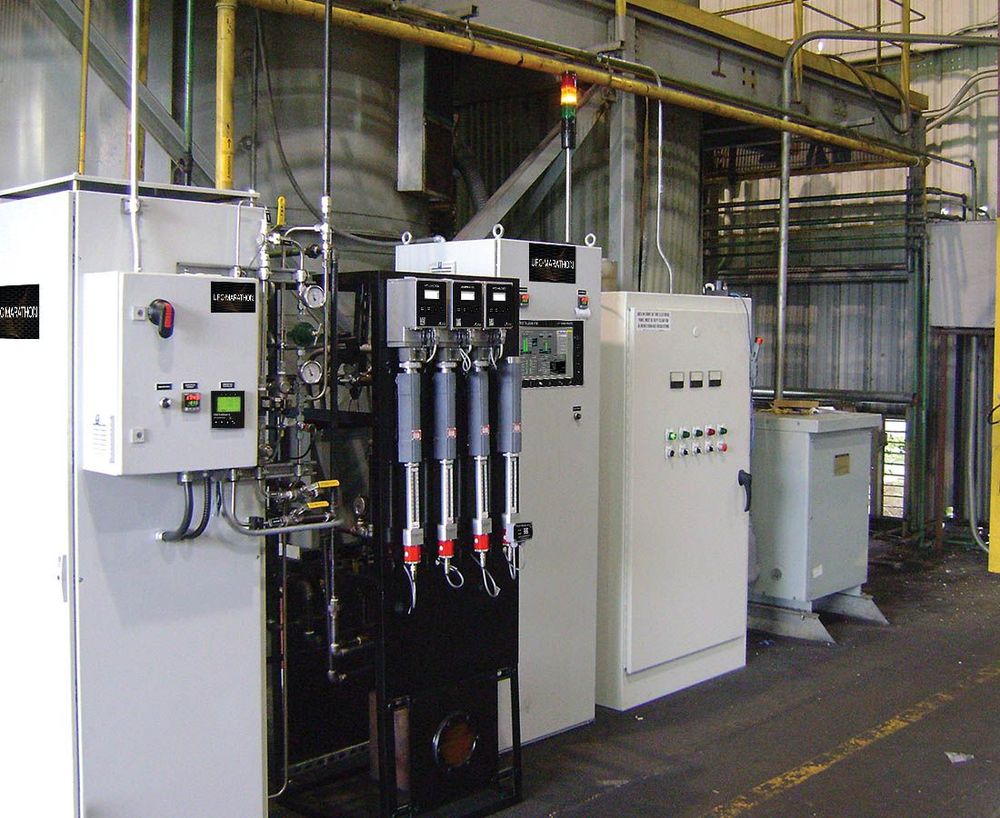
Upgrading Heat Treatment Furnace Controls: Which Instruments Do You Actually Need?
A carburizing furnace shows a stable carbon potential, but the team is investigating inconsistent results. A nitriding operator sees an unexpected hydrogen reading. Maintenance knows a gas valve received an opening command, yet cannot confirm how much gas actually reached the process.
These situations raise a practical question: does the control system measure the condition you need to understand?
A furnace controls upgrade should connect process measurement, gas delivery and control decisions. For atmosphere heat treatment, that means choosing instruments around the application—not starting with the touchscreen.
Here is how to match common operating problems to UPC-Marathon instruments and controls.
1. Carburizing: examine the atmosphere measurement behind the number
When investigating carburizing variation, review the atmosphere measurement chain alongside the temperature history, recipe and load conditions. A stable display alone does not establish that the measurement represents the process correctly.
UPC-Marathon’s CarbonSeer carbon probe is designed for high-carbon applications and includes a saturation burn-off feature. Probe selection should account for the furnace application, installation, operating conditions and maintenance requirements.
The controller matters too. UPC’s carburizing control solutions include carbon potential control, oxygen-probe monitoring and Probe Care functions, with packages available as controller-only solutions, retrofit plates or complete panels.
Ask before upgrading: Can maintenance review probe condition and relevant process history? What checks and probe-care procedures will be used? Which functions are included in the proposed configuration?
The goal is a measurement and control arrangement the team can evaluate and maintain.
2. Nitriding: distinguish hydrogen measurement from process calculations
A nitriding application requires a different instrument discussion. Do not assume the measurement strategy used for carburizing transfers to nitriding.
H2Smart measures hydrogen in nitriding and nitrocarburizing atmospheres. Its integrated sampling system includes a pump and sampling-flow control.
Model selection is important. The base model measures hydrogen concentration; the LT adds simplified nitriding-potential, or Kₙ, calculation; the PRO adds extended atmosphere calculations, including Kₙ, K꜀, Kₒ and dissociation.
Ask before upgrading: Does the application require hydrogen measurement alone or additional calculated parameters? Which gas inputs and process assumptions must be established for the selected calculation?
Also distinguish analyzer sampling flow from furnace gas delivery. Reliable flow through an analyzer helps support its measurement; it does not establish the flow entering the furnace. These are separate checks.
3. Gas delivery: measure flow rather than infer it from valve position
A valve command tells you what the control system requested. It does not, by itself, tell you the delivered flow.
VersaMeter uses differential-pressure flow measurement and offers flow alarms and consumption totalizing. These functions can help teams examine flow conditions and consumption over a defined operating period.
Where automatic flow regulation is required, Valve-Tronic Plus combines flow measurement and control. Its display includes actual flow, totalized flow, valve position, alarms and diagnostic information.
Ask before upgrading: Do you need local indication, recorded measurement, automatic regulation or a combination? Confirm the gas or liquid, operating pressures, required flow range, calibration basis and control-system interface.
A useful trend should distinguish commanded values from measured values. That makes the record more informative when investigating an atmosphere excursion or a gas-delivery problem.
4. Additional gas measurements: choose the variable that answers the question
An atmosphere-control problem may require more information than the existing instrumentation provides.
AtmoSense is a single-gas analyzer available with sensor options for variables including hydrogen, carbon monoxide, carbon dioxide, methane and dew point. It can operate independently or integrate into a new or existing control system.
The important word is “single.” One AtmoSense unit should not be specified as though it measures every listed variable simultaneously.
Ask before upgrading: What measurement would help resolve the operating question? Then establish the appropriate sensor, range, sample location and sample-handling requirements.
Adding an analyzer should close a defined information gap. It should also come with a plan for checking and maintaining the measurement.
5. Connect instruments to recipes, alarms and usable history
Once the measurements are defined, decide how operators and maintenance will use them.
ActivePLC and ActiveHMI provide a UPC control platform using Allen-Bradley or Siemens PLC hardware. Listed functions include PID control, recipes, alarm logs, data logging and a paperless recorder.
For each critical variable, specify the required signal, display, alarm and historical record. During commissioning, demonstrate a realistic task: can the team retrieve the temperature, atmosphere and flow information needed to investigate a particular cycle?
Confirm the included hardware, software, interfaces and configuration. A product feature list is the starting point for the specification.
Build the upgrade around five practical checks
Before requesting a proposal, assemble:
- Process scope: furnace type, atmosphere, gases and operating ranges.
- Measurement gaps: the conditions the team cannot currently verify.
- Instrument requirements: probe or analyzer selection, sample handling, flow range and calibration needs.
- Control requirements: recipes, measured-versus-commanded trends, alarms and records.
- Acceptance checks: representative operating tasks, maintenance access and responsibilities for production release.
This guide concerns controlled-atmosphere applications. Vacuum processing requires a different measurement strategy. Quench-medium selection and quench-system performance are separate engineering questions.
A focused upgrade may address a specific measurement gap; a broader retrofit may connect several instruments and control functions. Define the operating problem first, then select the equipment needed to address it.
Planning an atmosphere furnace controls upgrade? Contact UPC-Marathon with your furnace type, process gases, existing instruments and the problem you need to solve. Discuss the appropriate probes, analyzers, flow instruments and control configuration for your application.